
The Cheerambathur Lab studies the molecular pathways involved in building, maintaining and repairing the intricate architecture of the human brain.
During brain development, neurons establish precisely wired neural circuits with well-defined connectivity. Dendritic compartments form complex branching patterns, while axons navigate the dense extracellular environment to reach target sites and establish synaptic connectivity. Cytoskeletal remodelling triggered by external cues is a major driving force that facilitates neuronal wiring. However, the molecular pathways that link neuronal cytoskeletal dynamics to changes in the neuron morphology and connectivity are not well understood.
A primary aspect of our research is centered on the surprising and noncanonical role for the kinetochore in wiring of the brain. Kinetochores are highly specialized force-sensitive molecular machines, traditionally recognized for their role in chromosome segregation during cell division. Recent pioneering work from our lab and that of others has shown that kinetochores act as regulators of the cytoskeleton in post-mitotic neurons to shape the nervous system across worms, flies and mammals.
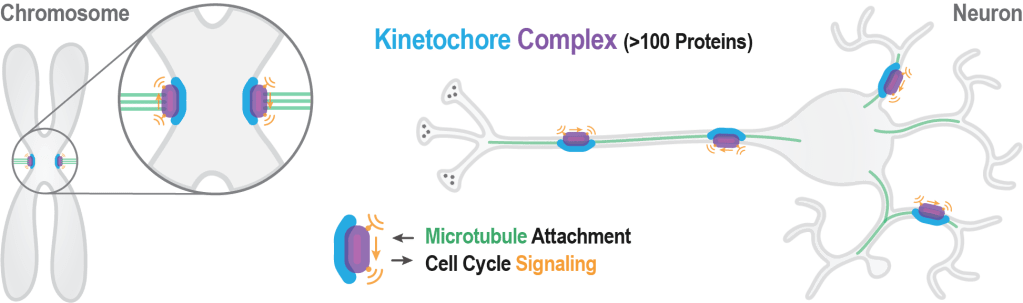
Kinetochore Complexes Modulate the Cytoskeleton to Shape the Nervous System
Using C. elegans and vertebrate systems we study how kinetochore components act beyond their cell division role and interact with the neuronal cytoskeleton and subcellular structures to aid in the formation and repair of neural networks. We employ an interdisciplinary approach using quantitative fluorescence microscopy, tissue-specific mass spectrometry, state-of-the-art genetic manipulation techniques and protein biochemistry to investigate neuronal kinetochore function.
Cheerambathur Lab research avenues:
 Cheerambathur Lab